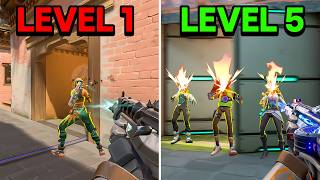

The 5 Levels of Aim in Valorant
45sHigh-level overview of aim levels sparks curiosity and sets expectations for the entire video.
▶ Play Clip"Delivers a solid breakdown of aim levels with actionable drills, though the coaching promo is a bit heavy."
This video by a professional Valorant coach breaks down aiming into five distinct levels, from Iron to professional play. It explains the characteristics of each level, common weaknesses, and provides specific drills and training methods to improve. The coach emphasizes that high-level aim is not just raw mechanics but also game sense, crosshair placement, and the ability to isolate fights.
The video introduces the concept of five levels of aiming in Valorant, from low ELO to professional play, and promises to describe each level and how to improve.
Beginner players struggle with mouse control, crosshair placement, and spray control. They lack confidence and aim speed. The main issue is raw aim.
Aim is broken down into target switching, flicking, tracking, and click timing. Each is defined with examples.
Use the Voltaic Valorant Benchmark to identify weaknesses. Practice in the range or deathmatch with specific scenarios for each skill.
The Voltaic benchmark and a linked Google Doc provide playlists targeting specific weaknesses.
Promotes a 10-week coaching program with Radiant coaches, offering lifetime access and a guarantee of at least 500 RR improvement.
Players have solid movement and raw aim, but lack polish. Spray control is often neglected, leading to shaky sprays.
Practice spraying at a wall from distance for 10-20 minutes every other day. Also, aim for first 5-8 shots in a circle at 20m, and practice spray transfers.
Players have mastered aim scenarios and execute mechanically well. They focus on attention to detail, especially crosshair placement and awareness.
Focus on map details like elevation changes and multiple angles. Consider probabilities of enemy positions and pre-aim accordingly.
Pros have near-perfect mechanics and game sense. They miss fewer flicks and have composure. They isolate fights using game sense, making clutches look clean.
Players like Aspas, Demon1, TenZ, etc., push boundaries with revolutionary aim styles. They define the meta and force others to adapt.
Accept that only a few will reach this level. Master fundamentals (levels 1-3) to be top 0.02%, then innovate with a mechanic, like Prxmi's crouch peek.
Aiming in Valorant is a multi-layered skill that evolves from raw mechanics to game sense and innovation. By systematically addressing weaknesses and understanding the nuances of each level, players can significantly improve their aim and rank.
What are the four categories of aim mentioned?
Target switching, flicking, tracking, and click timing.
01:59
What is the main problem for level 1 aimers (Iron-Gold)?
Mouse control and raw aim.
01:07
What drill is recommended for spray control?
Stand far from a wall and spray for 10-20 minutes every other day.
05:25
What is a contact setup?
A defensive setup where player A takes a position that results in the enemy being exposed when they fight player A, and player B waits for the sound of shots before swinging.
09:40
What makes pro players' aim appear better?
Their game sense allows them to isolate fights and think ahead, making their aim more effective.
10:32
How can one achieve level 5 aim?
Master the fundamentals (levels 1-3) and then innovate with a mechanic in a revolutionary way.
12:55
Aim Categories
Provides a clear framework for understanding and training different aspects of aim.
01:46Spray Control Drill
Simple, actionable drill that can significantly improve consistency.
05:25Crosshair Placement Probabilities
Explains that crosshair placement is about predicting the most likely enemy positions.
07:54Pros Isolate Fights
Highlights that pro aim is enabled by game sense, not just raw mechanics.
10:32Ye's Revolutionary Aim
Shows how top players define the meta with innovative techniques.
12:03[00:02] game strives to pull off insane shots and get clips like this. almost universally satisfying. They're the reason why games like Counter-Strike
[00:15] still exist and thrive after decades. So, how can we reach that level of mechanical satisfaction in Valorant? And more importantly, what levels of aim are achievable? And what difference is there between each level of aim in Valorant?
[00:28] I've coached thousands of players and their mechanics to Immortal Plus, and in this video, I'll go over five levels of aiming starting from low ELO up to the best of the best. I'll describe each level, explain what makes the top aimers
[00:40] so good, and how to improve and achieve each level of aim. Starting off, level one is from Iron to Gold, the beginner player and the slightly more experienced player. At this level, Valorant's aim is usually slower and less precise because
[00:53] at this rank are also getting used to stopping for shooting can still be challenging, especially when you're level one aimers can still achieve good flicks, they often struggle with some
[01:07] basic aspects of aim, such as having consistent crosshair placement, having inconsistent spray control. All of these issues stem from one main problem, mouse control and raw aim. Many silver or bronze players simply don't have solid
[01:21] they lack confidence and therefore aim speed. [music] Many players misunderstand this balance between speed and accuracy and its value. They focus on flashy movement, Asian tag, or trying
[01:34] to out-strafe their opponent. But in reality, a few range drills and possibly even some aim labs could do wonders for your raw aim and help you climb out fast. So, what exactly should you do when trying to practice your raw aim?
[01:46] For a level one aimer, we want to practice a wide range of skills initially and work towards targeting our weaknesses over a longer period. Most experienced aimers break up aim into the following categories: target switching,
[01:59] flicking, tracking, and click timing. For example, target switching is when enemy to the other in let's say [music] a clutch situation. Flicking is the act of moving your crosshair precisely on the enemy peeking out. Tracking is
[02:12] applied when an enemy is dropping from heaven or when a Reyna is flying over you. And finally, click timing is when you pre-aim our crosshair and shoot the enemy peeking out exactly when they line up with our crosshair. [music]
[02:24] with Voltaic Valorant Benchmark to identify your strengths and weaknesses. You can also practice most, if not all of these skills, in the range or deathmatch. For example, a tracking scenario could be following a bot's head
[02:37] around it with various distances inside the range. And alternatively, for target switching, give yourself some elevation in the range using the boxes or Sage targets at a time. If you want to improve your click timing, playing
[02:51] shots to where the enemy is moving will be helpful. Every player has different weak points, so your goal is to identify your aim weaknesses and focus your training on that specific skill. And again, you can use the Voltaic Valorant
[03:04] Benchmark to find your exact aim weaknesses, and you can also use this Google Doc to find playlists targeting your weak point. Now, I understand that trainers and watching guides can feel pointless and unclear, especially if
[03:18] exact tip directly pertains to your current struggles of ranking up. So, if to work on, and you want to finally hit your dream rank like our thousands of is built exactly for you. Inside our
[03:32] 10-week premium coaching program, you'll get over 100 hours of personalized, hands-on help from Radiant and BCD coaches. And for a limited time only, until the end of this year, we're giving away lifetime access to our coaching
[03:45] getting you results that if you don't rank up at least 500 RR in 10 weeks, example, check out these students that gained up to 800 RR in just four weeks.
[03:57] So, don't wait and use the link down below to book a free call with me or one of our coaches to see if we'd be a good fit. Now, moving on to level two, plat all the way to Immortal one. And I'm sure you would agree that players' aim
[04:10] at these ranks sometimes not correlate to their ranks. You see some incredible aimers in plat and some pretty subpar ones in Ascendant. Why? Because aiming is not the only skill at play in ranked. Some players rely on their mechanics and
[04:22] some players on game sense and utility. And additionally, as you climb, aim becomes more than just your ability to move your crosshair from point A to point [music] B. Players in the second level generally have solid movement and
[04:34] good raw aim. And the raw aim is often not the issue here, but rather other factors, such as how they anticipate gunfights and their comfort level with the guns themselves. These skills lead to more precision and control in fights.
[04:46] However, their mechanics are likely still in need of some polish. Polish that becomes a defining factor if your goals are set on the top ranks. For example, the first skill that I can absolutely guarantee is an issue for
[04:59] Trust me, I've seen hundreds of VODs from these ranks during my time coaching, and I can say without a doubt that surprisingly spray control is just not valued as much in these ranks as it is in higher ELO. And for this reason,
[05:13] you see a lot more shaky, uncontrolled sprays, and it really makes your game look unpolished. This is actually great news though, because spray control is actually very easily practiced, and this alone can elevate your game to a new
[05:25] your spray. Stand far back from the wall in the range and just spray away. I know, revolutionary. However, if you do 10 to 20 minutes of this, even just once every other day, it will completely transform your consistency in game. And
[05:39] another drill to train your spray control is to use a target in the range and aim for the first five to eight shots to fall inside the first circle at a 20-m distance. You can also practice spray transfers by targeting multiple
[05:51] moving targets on the practice bots. The truth is that as simple as it might control of your spray, more situations become manageable. So, the next time you play, just consider how many fights feel uncertain because you were worried about
[06:04] you notice this, just try the methods I gave you for just one to two weeks. And this confidence in your spray will make a lot more of a well-rounded player. Now, the third level of Valorant aim is where we find the more advanced and the
[06:17] around the Immortal 2 to Radiant level. These players have mastered all the aim scenario, executing mechanical plays correctly in most situations. They don't need to think of their aim actively, and they're usually fairly consistent with
[06:31] aspect of the game at this level, since you also need to be knowledgeable about your game sense, Asian utility, and many other aspects. And a good way to sum up Ascendant player and an Immortal 3 player is simply their attention to
[06:45] detail. And having attention to detail in all areas of your mechanics is talking about awareness and crosshair placement as these tie directly into a ELO, a mechanically well-rounded player is exactly what you need to be.
[07:00] training routine is necessary. [music] And in fact, most players in this ELO aim train based on how their mechanics feel from day to day. But it's not just so in the top ranks in the game. While your crosshair placement might feel like
[07:15] it's pretty solid, it can always be better. So, to learn this, we really need to focus on the details around the map and how they affect our crosshair placement, such as elevation changes or multiple angles lining up with one
[07:27] intrinsically [music] know what angles are good or bad. So, [music] and lower for a swing further away from you. And this usually comes down to details such as peeking [music] into an angle with multiple elevations
[07:41] or possible trades from uncleared position. And to reach this level, you first need to consider probabilities and understand where people feel comfortable playing in any given scenario. For example, if you peek Garden on B long as
[07:54] your crosshair placement for the flowers off-angle. Why? Because any decent player will understand that it's better to be up on the off-angle than to be on ground level. When we're playing in the off-angle, players are forced to adjust
[08:08] they're more likely to be slower at aiming here. And this is why it makes sense to prioritize the flowers' pre-aim and simply adjust if they are below. And this is the key with aim and crosshair placement. It's not about knowing every
[08:22] but it's about guessing what the best, most probable positions are for [music] the enemies to be playing in and placing our crosshairs as close as possible to their head. So, on top of having almost perfect basic mechanics, Immortal and
[08:35] sense that allow them to predict the most likely place consistently. Now, moving on to level four, the pros. Professional players are literally in a race with each other every single day over how much time and effort they put
[08:49] does this actually look in game? Pros miss fewer flicks, and the speed at which they are aiming at is often they have to get a kill. And this composure is made up of many smaller
[09:04] skills. At this level, mechanics are a byproduct of game sense. They have the raw aim and the movement, sure, but so does everybody else at this level. So, what allows for their crazy reaction times and quick judgment is their
[09:16] understanding of what's going on around them and their ability to think ahead. For example, pro players are much better than your average Immortal or Radiant at baiting a movement. They can go into a retake and read the kind of crossfire or
[09:28] setup that defenders are most likely to play. They can also read a contact setup and use jiggle peaks or utility to fake the contact. For those of you who don't know, a contact setup is a defensive setup most often used in defensive site
[09:40] hold. A setup where player A takes a position that results in the enemy being position at the moment they take a fight with player A, and player B takes a position where they can also fight the
[09:53] enemy upon this contact, then waits for the sound of shots or even the mini map before swinging out and fighting. This often happens naturally without communication at this level, so it's vital for pros to learn how to break
[10:05] these kinds of setups. Pros can often get info on one player out of maybe two or three involved in a setup or site hold. And then, based on that information, understand where the other player needs to play in order to play
[10:18] these patterns and make decisions [music] very quickly, making impossible clutch situations more manageable mechanically, all because they think a step or two ahead of you. So, how is any of this related to their aim? Because,
[10:32] like I said, these players all already have incredible aim, and it's totally players peaking you at the same [music] time with and you will somehow kill all three before they can hit a shot. So, to utilize their incredible aim, they must
[10:45] be able to isolate fights. And this ends up in really clean-looking clutches where you might think, "Wow, that guy has incredible aim." But, in actuality, knowledge that led to their aim being put on display. So, if all pros can aim
[10:59] well, and they can all isolate tools well, then why do some of them clearly dominate and stand out above even the rest of the pros? And this is where where you find the best of the best of aimers, the goats. Some professional
[11:13] players clearly stand out for their flashy highlights and ability to come out on top in the worst, most chaotic situations. That's where we find our fifth and final level of aiming in Valorant, the kind of players who have
[11:25] round, and you instantly know that the momentum has shifted in their favor. Because when they're on, they can't be stopped, and everybody knows it. We're thinking of the prominent names here, like Aspas, Demon1, Prime Ye, Prxmi,
[11:38] like Aspas, Demon1, Prime Ye, Prxmi, TenZ, Zekken, etc. What makes these pros the boundaries of what was thought possible with their aim and mechanics. Think back to every time a new name caught your attention. Almost every time
[11:51] it's because they've done things you've never seen before. For example, when Ye had his best year, his aim style was not something commonly seen in VCT at the time. This might be hard to understand now, since we see it so often, but he
[12:03] Valorant's tap and burst movement and aim style. He was also the first to heavily rely on ADS for better first bullet accuracy. And he mastered the Chamber Headhunter before anyone else. And even before that, we saw TenZ in the
[12:16] first year of Valorant show the world how to use Jett to its fullest extent. He was faster than anyone else with Jett's dash by far, and he used the dash and updraft to go for fights that were previously thought to be way risky. His
[12:28] allowed success in these scenarios. The majority of the players coming at the time were coming from Counter-Strike and had to learn to expect and adapt to this players define the meta. They force others to adapt by demonstrating a new
[12:42] style, or as Aspas does, they perfect every single aim mechanic to its fullest potential. So, I know as crazy as it might sound, how do we get to that accept that this level will only be achieved by a few players ever in the
[12:55] lifespan of a game. But, if you're really wondering how one gets to be the fundamentals of aiming that we mentioned in the first three levels, and that already puts you in the top 0.02% of players. And after that, you
[13:07] basically have to take one of the mechanics and use it in a revolutionary way. For example, how Prxmi popularized the crouch peak and crouch tapping at many of us will never achieve, but that's how we get to level five. And
[13:21] let me know what you think in the comments and if you want to achieve better aim, use the link down below to book a free call with me or one of our book a free call with me or one of our team members. Thanks for watching.
⚡ Saved you 0h 13m reading this? Transcribe any YouTube video for free — no signup needed.