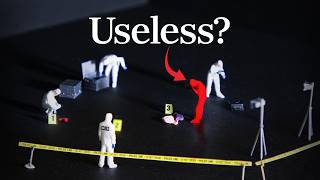

The Ancient Sickle Trick That Solved a Murder
45sThe historical 1247 forensic case is surprising and visually intriguing, hooking viewers with a clever, primitive detective method.
▶ Play Clip"The title accurately reflects the video's content, which investigates and ranks the accuracy of five forensic methods, delivering exactly what it promises."
This video investigates the accuracy of five common forensic techniques: microscopic hair analysis, bite mark analysis, bloodstain pattern analysis, fingerprint analysis, and DNA analysis. It reveals that despite their widespread use in court, many of these methods lack rigorous scientific validation and are prone to errors, biases, and misinterpretations.
The earliest known forensic method is from a 1247 Chinese book, 'The Washing Away of Wrongs', where flies landed on a murderer's sickle, revealing the weapon.
A 2009 National Academy of Sciences report stated that except for nuclear DNA analysis, no forensic method has been rigorously shown to consistently connect evidence to a specific individual.
FBI examiners routinely claimed matches between hairs from different people, and sometimes couldn't tell human hair from dog hair. Out of 268 cases, 96% were declared false, with 33 people sentenced to death and 9 executed before errors were found.
Studies show bite marks on skin are not reliable due to skin distortion. Despite this, bite mark evidence is still allowed in courts worldwide, even as recently as 2025.
The method assumes straight-line trajectories, ignoring gravity and drag. A 2021 study found analysts disagree on how a stain was made about 8% of the time. New software using fluid dynamics is improving accuracy.
Fingerprint examiners often disagree on the number of minutiae points, and the same examiner may reach different conclusions 10% of the time. Contextual bias (e.g., knowing the suspect's criminal record) can influence results.
Increasing sensitivity leads to issues like trace DNA transfer (e.g., a homeless man's DNA transferred to a murder scene). DNA mixtures from multiple individuals are difficult to interpret, with a 2013 NIST study showing 69% of labs got the analysis wrong.
While forensic techniques have improved, many still lack rigorous scientific validation and are prone to errors and biases. The video emphasizes the need for continued reassessment and improvement to ensure forensics remains a reliable science.
The Washing Away of Wrongs
book
Flight Characteristics and Stain Patterns of Human Blood
book
Song Ci
person
Mary Bush
person
Herbert Leon MacDonell
person
Edward Henry
person
Azizul Haque
person
Hem Chandra Bose
person
Brandon Mayfield
person
Lucas Anderson
person
Saily
tool
Elements of Truth game
link
What was the first known empirical forensic method, and from which book?
Flies landing on a murderer's sickle, from 'The Washing Away of Wrongs' by Song Ci (1247).
According to the 2009 National Academy of Sciences report, which forensic method was rigorously shown to connect evidence to a specific individual?
Nuclear DNA analysis.
1:13
What percentage of FBI microscopic hair analysis cases were declared false upon reexamination with DNA?
96%.
3:08
How many people were sentenced to death based on flawed microscopic hair analysis?
33 people.
3:15
Why is bite mark analysis considered unreliable?
Skin is soft and distorts under pressure, so bite marks on skin do not reliably match the biter's teeth.
4:48
What is the main flaw in traditional bloodstain pattern analysis?
It assumes blood droplets travel in straight lines, ignoring gravity and drag.
6:49
What percentage of the time do fingerprint examiners reach a different decision when given the same pair of prints twice?
10% of the time.
14:31
What is the name of the bias where knowing the context of a case influences a forensic examiner's conclusion?
Conformity bias (or contextual bias).
16:07
In the 2013 NIST study, what percentage of labs incorrectly interpreted a DNA mixture from four individuals?
69%.
20:44
What is the main problem with DNA mixtures?
Profiles from multiple individuals overlap, making it difficult to determine which peaks belong to whom.
19:51
NAS Report on Forensics
Establishes that most forensic methods lack rigorous scientific validation, challenging their reliability in court.
1:13Hair Analysis False Positive Rate
Reveals a staggering 96% false positive rate in FBI hair analysis cases, leading to wrongful convictions and executions.
3:08Bite Mark Unreliability
Demonstrates through studies that bite marks on skin are not reliable, yet the technique remains in use.
4:48Fingerprint Examiner Inconsistency
Shows that even expert fingerprint examiners disagree 10% of the time on the same prints, undermining claims of 100% certainty.
14:31DNA Mixture Interpretation Errors
Highlights that 69% of labs misinterpreted a controlled DNA mixture, exposing a major flaw in a supposedly gold-standard technique.
20:44[00:00] (dramatic music)
[00:03] - A man has been found lying dead
[00:05] at the side of the road with oozing,
[00:07] elongated wounds to his back.
[00:09] To solve the murder,
[00:10] a local official calls all
[00:13] and demands they all bring
[00:16] In the square, each man is
[00:19] And then something
[00:23] In the rising heat of the
[00:26] all landing on a single sickle.
[00:29] Its owner buckles,
[00:30] falling to his knees and admits to murder.
[00:36] This is from a 1247 book,
[00:38] "The Washing Away of Wrongs" by Song Ci.
[00:40] And it's the first writing we have
[00:42] of an empirical approach to forensics.
[00:44] But okay, big deal.
[00:46] Anyone could have just swapped the sickles
[00:47] or used their neighbor's.
[00:50] But forensics today are
[00:54] Fingerprints support investigations
[00:58] and DNA evidence in more than 90%.
[01:00] But then you also read an article like
[01:02] "Hair sample that put men
[01:06] turned out to be dog hair."
[01:07] - That is not science.
[01:09] That is not justice.
[01:10] - See, in 2009, the
[01:13] published this 350 page
[01:17] with the exception of
[01:19] no forensic method has
[01:22] to consistently demonstrate a connection
[01:24] between evidence and
[01:26] And they also said that some tests
[01:28] do not meet the fundamental
[01:31] So we ask people to rank five
[01:34] all of which are still
[01:38] Okay, five forensic techniques here.
[01:39] And I just need you to rank them in order
[01:41] of accuracy from the
[01:43] to the most accurate.
[01:44] So what do you think?
[01:45] - I don't know if I'm gonna nail these.
[01:47] - Whoa. I dunno.
[01:48] - I don't know what
[01:50] - Okay, hair. What are you thinking?
[01:52] - I think hair is last, eh?
[01:53] - I would probably put
[01:57] - I feel like hair would
[02:00] - To fake?
[02:01] - I think hair at the bottom,
[02:04] because if it's not got
[02:05] just hair in general.
[02:07] - Mm.
[02:08] - Yeah.
[02:09] (dramatic music)
[02:11] - Hair has always been
[02:13] for crime scene investigators.
[02:15] And before DNA, they would look
[02:17] for the microscopic
[02:19] and the cross section of
[02:22] For example, analyzing
[02:25] like structure of the
[02:27] or how the pigment is distributed
[02:30] - [Announcer] The examiner's trained eye
[02:31] can learn many things.
[02:33] Is it human hair? Of what race?
[02:35] Animal hair? What family?
[02:37] This vital information may help
[02:39] to establish guilt or innocence
[02:41] - Between the 1970s and 1999,
[02:44] the FBI used this against
[02:49] But when they later reexamined
[02:52] it completely flipped
[02:55] and it turned out that even
[02:58] examiners would routinely
[03:00] between hairs that were
[03:02] And they sometimes couldn't
[03:04] between a human hair and a dog hair.
[03:07] (dog barking)
[03:08] Out of those 268 cases that
[03:12] 96% were declared false.
[03:15] 33 people were already sentenced to death,
[03:17] and nine were already executed
[03:19] by the time the errors were found.
[03:21] Today, the FBI only uses hair as evidence
[03:24] if it can be supported by DNA testing,
[03:26] which is why microscopic hair analysis
[03:28] goes to the bottom of this list.
[03:30] What do you think of bite marks?
[03:31] - On a crime scene?
[03:32] - Yeah, yeah.
[03:33] Dracula, is Dracula there?
[03:34] - Least accurate is gonna be
[03:36] pretty close to bite marks, I think.
[03:38] - Midway.
[03:39] - Midway?
[03:40] That's last.
[03:41] That's not realistic, innit?
[03:43] Mm.
[03:44] Bite marks at the top.
[03:45] The idea behind bite marks is simple.
[03:47] If you can use dental records
[03:50] surely you can identify a perpetrator
[03:52] by the bite marks left on a victim.
[03:54] Since the 1950s,
[03:55] bite mark analysis has been
[03:59] But then some experts, like
[04:02] started looking into
[04:05] - There was no scientific exploration
[04:08] into bite marks before they
[04:11] to say that this was even a feasible
[04:13] technique that you could do.
[04:15] - One study from the university at Buffalo
[04:17] used a set of model teeth to create
[04:19] 89 bite marks in cadavers,
[04:21] alongside controlled
[04:24] And out of those 89
[04:27] none of them matched the measurements
[04:28] of the ones made in wax or
[04:31] In fact, when they compared
[04:34] to a wider collection of 411 model teeth,
[04:37] it wasn't even the original
[04:40] that was the closest match.
[04:42] After 12 studies, their conclusion,
[04:45] bite mark transfer to
[04:48] Skin isn't a good medium
[04:49] to leave an imprint of
[04:51] It's soft, it's squishy, and
[04:54] But despite all this,
[04:57] and bite mark evidence is still
[05:00] We asked Dr. Bush for a comment
[05:02] and she said that while
[05:04] is happy to discard an
[05:08] the justice system prefers consistency
[05:09] in a historical precedent.
[05:11] So even the new flurry
[05:13] to get bite marks out of court.
[05:15] In fact, bite marks have
[05:17] as recently as 2025,
[05:19] which is why it gets the
[05:23] Blood, if you don't have DNA
[05:24] and you're just using
[05:26] that it leaves along the ground.
[05:27] How they splat.
[05:28] - [Gregor] Like the picture,
[05:29] that blood on a crime
[05:31] - Okay.
[05:32] thinking of putting blood at the end,
[05:33] but like, I don't know.
[05:34] Put blood at the end.
[05:35] - I would go blood then
[05:36] - Second.
[05:37] - Yeah, yeah, yeah, yeah.
[05:38] - So bloodstain pattern analysis.
[05:40] When someone is injured,
[05:43] and drips into the environment
[05:45] And in 2020, "Wired"
[05:48] with a crime scene analyst
[05:49] on how these different
[05:52] You can use physics and
[05:55] and extrapolate where in space
[05:57] the blood must have come from.
[05:59] This all started in 1971 when chemist,
[06:01] Herbert Leon MacDonell, published
[06:03] "Flight Characteristics and
[06:06] In this book, MacDonell
[06:08] the width and length of a stain
[06:10] to calculate the angle of impact,
[06:12] and then using trigonometry,
[06:14] trace that back to the point
[06:18] The book quickly became the foundation
[06:20] of bloodstain pattern analysis,
[06:21] and everyone was using it.
[06:23] In fact, MacDonell even
[06:26] where thousands of US police
[06:29] The Supreme Court of Iowa
[06:32] as relatively uncomplicated.
[06:34] So they didn't require
[06:37] They were happy to go
[06:39] that he did alone in his basement.
[06:42] And soon enough,
[06:44] was used in courts all over the states.
[06:48] But here's the problem.
[06:49] Plotting the flight
[06:51] using trigonometry
[06:53] were straight lines and gives
[06:57] which suggests the victim was standing up.
[07:00] The issue is,
[07:01] MacDonell and then many forensic
[07:04] and even "Wired," failed to account
[07:05] for the effects of gravity and drag
[07:07] as obvious as this sounds.
[07:09] When you include these
[07:11] the common origin point lowers,
[07:13] and you can see that in this example.
[07:14] It's more likely that the victim
[07:18] The first study to measure
[07:21] of bloodstain pattern analysis
[07:25] That's over 50 years
[07:27] after it started being admitted in court.
[07:29] And a large scale study from
[07:32] come to different conclusions
[07:35] about 8% of the time.
[07:36] And that's because the same stain
[07:37] can come from many different mechanisms.
[07:39] And the fact that blood
[07:42] depending on how many red blood cells
[07:43] versus the plasma you have.
[07:45] Men actually tend to have
[07:48] of blood cells than women,
[07:50] which makes their blood more viscous.
[07:52] Nowadays, investigators have new software
[07:54] which uses fluid dynamics
[07:56] to help them map these complex 3D seams.
[07:58] So bloodstain pattern analysis
[08:02] which is why it gets this
[08:04] Okay.
[08:05] But surely fingerprints
[08:07] must have a lot of
[08:09] How unique do you think fingerprints are?
[08:11] - I think they're pretty accurate.
[08:13] - They're fingerprints.
[08:14] - That's probably one.
[08:15] - Yeah.
[08:16] I mean, yeah, you use
[08:18] you unlock it, you pay stuff, right?
[08:19] - 'Cause fingerprints are unique.
[08:21] Even when you have a passport,
[08:22] like they scan you when
[08:25] - On March 11th, 2004,
[08:27] a terrorist organization
[08:29] set off explosions on
[08:32] The attack killed 193 people
[08:37] Quickly after, the police
[08:39] on a detonator bag left behind,
[08:41] and they matched it to Brandon Mayfield,
[08:43] a lawyer in Oregon.
[08:45] There's only one problem,
[08:47] there are no records of
[08:50] He doesn't even own a passport.
[08:52] So how could he have pulled this off?
[08:55] - I honestly felt like I was being framed
[08:57] because I hadn't been outta
[09:00] - But despite that, the
[09:02] was considered so damning that
[09:06] But this wasn't a glitch.
[09:08] It was built into the
[09:10] (groovy music)
[09:12] In 1890s Kolkata,
[09:13] the city's rich career
[09:15] by paying people to
[09:18] It was a good tactic since, at the time,
[09:20] there was no practical
[09:23] So the criminals were
[09:25] Three officers, Edward Henry, Azizul Haque
[09:27] and Hem Chandra Bose
[09:28] started taking the prints
[09:29] of everyone who came through the station,
[09:32] but they quickly ran into a problem.
[09:34] When they got a suspect in,
[09:37] how could they crosscheck their prints
[09:39] against their own database
[09:40] when there were 10 prints per person
[09:42] and thousands of people coming through?
[09:44] They needed a classification system.
[09:47] Haque proposed that they should look at
[09:49] whether a fingerprint has a whirl.
[09:51] It's the spiral pattern
[09:52] that a person might have on their fingers.
[09:54] And because each of your 10 digits
[09:56] can either have a whirl or not,
[09:59] there are a total of
[10:01] or 1024 ways your whirls can be arranged.
[10:05] So the officers just built
[10:09] to organize these fingerprints.
[10:13] Okay.
[10:13] But what if like me,
[10:15] Well, two thirds of the
[10:18] So the system had to go further.
[10:20] Once you have a pigeonhole number,
[10:21] you go for additional
[10:24] Some of the additional categories
[10:25] that you could assign included
[10:28] which was denoted with the letter A,
[10:30] or whether you had a tented arch,
[10:32] which was denoted with a T.
[10:34] Similarly, you could look at which side
[10:36] of the finger this loop structure is on.
[10:38] And with a few more
[10:41] we get a much more
[10:44] one that would go on to be
[10:48] Famously, the world's
[10:51] which was established in London
[10:54] used this fingerprinting system.
[10:56] - I started in 1988
[10:59] in forensic services.
[11:01] - Could you paint a
[11:04] would've looked like with
[11:06] How big was this space?
[11:07] - So we're looking at a space of about
[11:10] 30 to 40 meters in length
[11:12] and about 10 to 20 meters in width.
[11:15] The collection at the time was about
[11:18] 3 to 4 million I think.
[11:19] - That is intense.
[11:20] Yeah, that's wow.
[11:21] - It's a lot of fingerprints.
[11:24] - Now, today's system takes into account
[11:27] these little details along the ridges.
[11:29] It's called friction ridge analysis.
[11:31] And well, it's no surprise that
[11:32] combing through pigeon holes
[11:35] but online databases today can
[11:37] (phone ringing)
[11:41] No way this phone works.
[11:44] Hello?
[11:46] Just trying to get a hold of you.
[11:47] - Why are you calling
[11:49] (caller speaks faintly)
[11:50] You have no data?
[11:51] Just get Saily.
[11:53] - You know, I travel a lot for filming.
[11:54] I actually just got to London.
[11:58] I always wanna be able to
[12:00] as soon as I land,
[12:01] and with the help of
[12:04] it couldn't be easier.
[12:06] First, you just scan the QR
[12:09] then you search your
[12:12] And next you just pick a data plan.
[12:14] And finally, during checkout,
[12:15] apply the coupon code Veritasium
[12:16] to get your exclusive 15% discount.
[12:19] No more dodgy cafe wifi or
[12:24] All you need to do is just
[12:25] switch on your mobile data when you land,
[12:27] and that's it.
[12:28] Saily works with all
[12:30] And once an eSIM is installed,
[12:33] you can keep adding plans in
[12:36] And in the rare case that your phone
[12:37] isn't compatible with Saily,
[12:39] you can get a full refund
[12:42] I've gone with the Saily Ultra Plan,
[12:43] which gets you unlimited data globally
[12:45] with access to airport
[12:48] and NordVPN, NordPass,
[12:52] So to stay connected on the
[12:54] you can scan this QR code, download Saily,
[12:57] and get 15% off your plan with
[13:00] So I wanna thank Saily for sponsoring
[13:02] this part of the video,
[13:03] and now back to our case.
[13:05] So if all the details
[13:08] into these databases,
[13:12] How is Brandon Mayfield falsely accused?
[13:15] Well, say you have a mark from a scene
[13:17] and you wanna run it through
[13:20] you can't actually search the
[13:24] because you first need to identify
[13:25] a number of features on the print.
[13:28] These are called minutiae.
[13:30] It's where the ridge line split or end.
[13:33] - To even search the database,
[13:36] you need a minimum number
[13:40] It's very efficiently sorted,
[13:42] hundreds of million prints,
[13:43] but it cannot make an ID.
[13:45] So what it does, it pulls
[13:49] at least 10, 20 up to
[13:54] And then the human
[13:58] - [Gregor] This works in
[14:00] how these minutiae are
[14:04] - What is interesting in my research
[14:06] published scientific reviewed research,
[14:09] the same thing one examiner
[14:14] and one sees 10 minutiae.
[14:16] So 10 minutiae is enough
[14:19] However, if the other are
[14:23] they couldn't run it.
[14:24] So whether you find a criminal or not
[14:27] depends on the luck of the draw.
[14:29] Even if you give the same pair of prints
[14:31] to the same examiner
[14:35] they will reach a different decision.
[14:38] - And these disagreements
[14:41] where the examiners had no
[14:44] but in reality, they often do.
[14:46] As many as 42% of the requests
[14:48] that fingerprint experts process
[14:50] state whether a suspect
[14:53] - In a recent case that I was involved
[14:57] where a firearm was involved
[14:59] and a forensic firearm expert
[15:02] had to decide whether a
[15:06] on the firearm, on the suspect.
[15:08] On the former submission form
[15:11] that was given to the forensic scientist,
[15:14] it said that it's homicide,
[15:17] it said the age of the
[15:20] and it even said the race.
[15:22] It said the suspect is black,
[15:24] and the person who died
[15:28] - For over a century,
[15:29] experts have held so much
[15:32] that in the FBI case for Mayfield,
[15:34] the examiners claimed with 100% certainty
[15:37] that that was his mark.
[15:39] This likely happened because
[15:41] was brought in to verify the match,
[15:43] they probably already knew the verdict
[15:45] of the original analyst,
[15:47] and they probably also knew the stakes
[15:49] of what a match could mean for the case,
[15:51] which made it all the easier to agree
[15:53] with the initial verdict.
[15:55] Even the fingerprint expert
[15:57] agreed that the mark matched
[16:01] when in reality, it belonged to a man
[16:03] who had links to terrorist
[16:07] This is the impact of conformity bias.
[16:09] - So all of this pressure,
[16:10] all of this context and intervention
[16:13] in the forensic science,
[16:15] I say to the police and the prosecutor,
[16:17] leave the forensic examiners alone.
[16:21] Give them independence of mind
[16:23] to make decision based on the
[16:28] and do the work rather than
[16:33] - Well, if there were issues
[16:35] with all these other techniques,
[16:37] why don't we just use,
[16:38] - DNA?
[16:40] - Yeah.
[16:41] - DNA has got to be surely,
[16:44] - It has to be DNA because,
[16:46] - You already know everyone
[16:48] - But even DNA analysis can
[16:52] Back in the 80s,
[16:53] you had to do this with a sample the size
[16:56] of a dime of blood or saliva.
[16:58] But today you can do it with
[17:00] In fact, just this year
[17:03] was solved with just 0.4 nanograms of DNA.
[17:08] But the paradox is, the
[17:11] of DNA analysis could
[17:15] In 2012, paramedics in
[17:18] about a severely intoxicated homeless man.
[17:21] They treated him and
[17:24] but along the way, they
[17:26] of his DNA on their equipment and gloves.
[17:29] Then later that night,
[17:31] of a businessman and they
[17:34] the homeless man's DNA to
[17:38] Because of that, the
[17:40] was charged with murder and
[17:43] despite being hospitalized at
[17:46] He spent five months in jail
[17:48] before charges were finally dropped.
[17:51] - So this is trace DNA and touch DNA,
[17:54] where you can get this kind
[17:57] - I see how that could be abused easily.
[17:59] So my DNA could be in a
[18:01] - Yeah.
[18:02] - And if DNA is deposited
[18:05] say a dark dry place, it can
[18:10] - And if, for example,
[18:14] well, loads of people are gonna
[18:16] so you're definitely going to get
[18:18] more than one profile off of there.
[18:21] - [Gregor] These samples
[18:23] are called DNA mixtures,
[18:25] and they have been found to be
[18:26] the most common source of
[18:29] - Some people shed more cells than others,
[18:32] so the majority of the
[18:35] off of that door handle may not be
[18:36] from the last person who touched it.
[18:38] - The problem in interpreting a mixture
[18:40] comes down to how a sample gets analyzed.
[18:43] The most common way to do it
[18:44] uses short tandem repeats or STRs.
[18:48] DNA is made up of four nucleotides,
[18:50] G, A, T and C.
[18:52] And the SDR method looks
[18:55] usually three to five nucleotides long
[18:57] repeat in your genome.
[18:59] For example, G-A-T-A, G-A-T-A and so on.
[19:02] For one person, they might
[19:06] whereas another individual
[19:10] A standard SDR test will look at around
[19:13] 20 locations on your genome
[19:14] for where these repeats can occur,
[19:16] and it will count how many repeats
[19:18] you have in each location.
[19:20] - So if you are looking
[19:23] and you've got one from
[19:25] you're actually getting 40 different
[19:27] genetic markers coming back.
[19:29] So the chances of somebody
[19:34] of genetic markers as you
[19:38] - Here's what a crime
[19:39] just one contributor
[19:43] You can see how it's easy to compare this
[19:44] to a sample from a suspect.
[19:47] But if the crime scene sample contains DNA
[19:49] from multiple individuals,
[19:51] then their profiles will begin to overlap,
[19:53] all with varying signal strengths.
[19:55] And the more individuals in the mixture,
[19:57] the more difficult these
[20:00] With four or more individuals,
[20:01] it becomes increasingly hard to compare
[20:03] a clean DNA profile from
[20:07] And now it's hard to
[20:09] was actually in the sample.
[20:10] You just can't tell which
[20:13] It's kind of like having
[20:15] at the same time.
[20:17] You can hear all the noise,
[20:18] but it's really hard to single one out.
[20:20] Now, some labs claim they
[20:24] of up to five individuals.
[20:26] And to test this,
[20:27] the National Institute of
[20:30] ran a controlled study in 2013.
[20:33] They've sent out a DNA mixture
[20:35] to labs all across the US.
[20:37] Their aim to see how different facilities
[20:40] interpret the same mixture of
[20:44] 69% of the labs got the analysis wrong.
[20:47] And despite the sample
[20:50] only 21% of the labs
[20:54] and not possible to give a comparison on.
[20:56] After NIST published the study,
[20:58] new checks have been imposed
[21:01] but there's still no lower limit
[21:03] on the quality or the
[21:05] that labs are permitted to analyze.
[21:08] And labs themselves still decide
[21:10] if something is too mixed or too partial.
[21:13] Now, you might think that
[21:14] using the entire sequence
[21:17] but that can actually introduce
[21:20] Now, your analyst has
[21:22] eye color, ethnicity,
[21:24] and that could introduce discrimination
[21:25] in the way the sample is being analyzed.
[21:28] - This is where the guidelines
[21:29] and the guardrails have to come in here.
[21:32] What are the genetic markers
[21:36] This is where the really interesting
[21:37] ethical questions come into it.
[21:39] People think that DNA is
[21:41] that will answer everything.
[21:44] And it is true.
[21:45] DNA evidence is incredibly powerful,
[21:48] it's amazing for identifying individuals,
[21:52] but DNA can never be taken out of context.
[21:57] - Now, the point of this
[22:00] I think it's still better
[22:01] where forensics exist rather
[22:05] But if we want to keep
[22:08] we need to continue the work of the people
[22:10] who actually made this video possible,
[22:12] who've dedicated their lives
[22:13] to already reassessing the field
[22:15] and making it as accurate as it is today.
[22:17] Do you think it's fair calling
[22:19] - I still think there's science in it
[22:21] because you're trying to do the best
[22:22] with the information you have,
[22:24] which is often times what
[22:27] with the information you have,
[22:28] this is the conclusions you make
[22:30] until you know something better.
[22:32] (gentle music)
[22:44] - Hey, one last thing.
[22:46] Last year we launched the
[22:49] Elements of Truth.
[22:50] It's a trivia game with 800 questions
[22:52] covering science and technology,
[22:54] and we on the team get quite competitive.
[22:56] So every time we play
[22:59] See, there's this mechanic
[23:00] where you can't only guess an answer,
[23:02] you have to put down a
[23:04] to gauge how confident you
[23:07] So it gets very fun very quickly.
[23:09] The game is coming out later this year,
[23:11] so if you're interested in pre-ordering,
[23:12] you can click the link in the description,
[23:14] which will take you to the
[23:17] Thank you so much for your
[23:19] And as always, thanks for watching.
⚡ Saved you 0h 23m reading this? Transcribe any YouTube video for free — no signup needed.