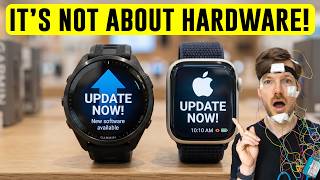

Why Your Smartwatch Is Already Outdated
55sChallenges the common belief that hardware upgrades matter most, revealing that software updates are the real game-changers.
▶ Play Clip"Title is catchy but content delivers a solid, data-backed argument that software matters more than hardware—mostly lives up to the promise."
This video argues that firmware and software updates are now more critical than hardware in smartwatch and health tracker performance. The creator, a post-doctoral scientist, uses personal data from Oura Ring and WHOOP to show how algorithm updates significantly impacted sleep tracking, and predicts that AI-driven 'third-order' health metrics like disease prediction will define future brand differentiation.
Most smartwatch brands have seen little hardware change recently; major differences now come from software, especially in health and sport metrics.
Level 1: direct measurements (heart rate, GPS). Level 2: derived metrics (sleep stages, apnea detection). Level 3: emerging, potentially most impactful—disease prediction models.
Deep sleep percentage dropped from ~23% to ~17% after the sleep staging 2.0 algorithm release, while hardware changes (Ring 3 to 4) had minimal effect. Standard deviation also halved.
Software and hardware updates together improved agreement with reference; creator suspects software was the main driver since sensors were nearly identical between generations.
Heart rate is a first-order derived metric (direct translation from PPG sensor). Sleep stages are second-order (calculated from heart rate and other data).
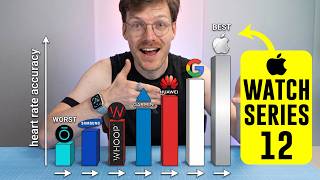
Brand (algorithms) is ~5x more important than sensor changes within a brand for heart rate accuracy. Pixel and Apple watches outperform sports brands due to AI expertise.
Foundation models (like ChatGPT's AI) applied to health can predict diseases from a single night of sleep (SleepFM study). Companies like Whoop, Oura, Eight Sleep are hiring AI specialists for this.
Third-order metrics could widen brand gaps and raise concerns about accuracy, privacy, price, and inequality. Creator questions if users want disease prediction from wearables.
Firmware and software are now the primary drivers of smartwatch performance, and AI-powered third-order health metrics will likely create a significant divide between brands in the coming years.
What are the three levels of health data defined in the video?
Level 1: direct measurements (heart rate, GPS). Level 2: derived metrics (sleep stages, apnea detection). Level 3: disease prediction models.
00:29
What was the impact of the Oura Ring's sleep staging 2.0 algorithm on deep sleep percentage?
Deep sleep dropped from ~23% to ~17% on average.
02:59
What is a first-order derived metric?
A metric directly translated from raw sensor data, like heart rate from PPG sensor.
05:44
What is a second-order derived metric?
A metric calculated from other metrics, like sleep stages from heart rate and other data.
05:17
How much more important is brand (algorithms) compared to sensor changes within a brand for heart rate accuracy?
Roughly five times more important.
06:56
What is SleepFM?
A foundation model that can predict future diseases from a single night of sleep in a sleep lab.
11:09
Which brands outperformed sports brands in heart rate accuracy according to the creator's testing?
Pixel watches and Apple watches.
07:35
Three levels of health data
Provides a clear framework for understanding how health metrics evolve in complexity and importance.
00:29Algorithm update changed deep sleep readings
Concrete data showing software can have a larger impact than hardware on health metrics.
02:59Brand matters 5x more than sensor
Quantifies the importance of algorithms over hardware, a key argument of the video.
06:56SleepFM predicts diseases from one night
Highlights the potential of AI foundation models in health tracking, a major future trend.
11:09[00:02] or Amazfit have released multiple devices per year. However, over the last few years in most smartwatch companies, not much has changed in terms of hardware. By now, the major changes are in the software, not the hardware, and
[00:17] this is where brands are actually setting themselves apart the most, especially when it comes to health and sport metrics. And here I actually need to talk about three levels of data. So
[00:29] far, the levels 1 and 2 have been the focus of most brands. So level 1 is more direct measurements like heart rate and GPS, and level 2 is more derived metrics like sleep stages and maybe sleep apnea detection. However, a third level is now
[00:43] becoming more and more important and could have the biggest influence on people's lives. Now, in this video, I'll argue using data that firmware and software have become more important than ever for sports and health tracking, and
[00:57] that this could be what sets apart the performance of these brands in the next few years. And I will show you that so far these software improvements have happened mostly in the first and second-order health metrics, but in a
[01:09] few years, the third-order health-derived metrics are likely going to set the brands apart even more and going to become more and more important. But this comes with some dangers. Even right now, firmware updates are probably
[01:22] as important in improving the performance of your smartwatch or in any health tracker as is the hardware. And the importance of the firmware is likely to keep increasing over time. So let's start by looking at some data. Now, by
[01:35] to the channel, my name is Rob, and I'm a post-doctoral scientist specializing in biological data analysis. Now, I actually want to start by looking at tracked by the Oura Ring and the Whoop Strap, and how firmware improvements
[01:49] have made huge changes here. Now, the Oura Ring is one of the most popular is true for the Whoop Strap. And I've been using both of these as my daily trackers for several years now. Now, this data is not as you see it on the
[02:02] website, but I process it a bit to make it a bit more easy to look at. And what we see here is my percentage of deep sleep over time, a bit smoothed out, with some major events marked on the axis. So, we have the time here along
[02:17] the horizontal axis, and then hardware changes are marked in orange, and firmware changes are marked in blue. went from the Oura Ring 2 right here to the Oura Ring 3, there might have been
[02:33] some changes, so my deep sleep increased a bit. Here I actually had a hard time poorly, so there was a bit of a decrease. But then, interestingly, there were two major firmware updates for the sleep stage tracking. It was the sleep
[02:46] staging 2.0 beta, and I actually doubt I was a part of this fully, because the was a part of this fully, because the major changes came right here. So, here, basically, the sleep stage algorithm 2.0 was released. This is with the Oura Ring
[02:59] 3, and you can see that there's a big dip in the percentage of my deep sleep. All of a sudden, this went from maybe on average, let's say, 23%
[03:12] to, let's say, on average afterwards, 17% or so. And you can also see right here that the Oura Ring 4 was released. However, with this launch of the Oura Ring 4, basically nothing changed with my deep sleep. So, here we can see that
[03:27] mature product, didn't make a huge difference, but software did make a big can especially see that if we look at the standard deviation. Now, this is basically means from day to day, how much does your deep sleep change? And we
[03:43] can see that before the 2.0 algorithm, it was always in this kind of range of, let's say, six. And then, the moment that new algorithm released, it went to maybe three or so. So, a huge dip in that standard deviation, and nothing
[03:58] much changed in terms of standard deviation in going to generation three right here, or in generation four right here. It was really that algorithm that made the difference. Now, actually, there was an improvement in my sleep
[04:10] stage tracking. However, I couldn't visualize this that well, because I'm lacking some data there. So, instead, I want to look at the WHOOP strap. Now, the WHOOP strap is a bit hard to evaluate here, because the major
[04:23] software changes actually came with also hardware changes. However, in going from hardware changes. However, in going from generation 3.0 here on the left to 4.0 here on the right, actually, there wasn't much change in hardware, at least
[04:38] not in terms of sensors. They were basically still identical. And this red line right here is sort of the average agreement with my reference, so we want that to be as high as possible. And we can see right here, when there was both
[04:50] a software and a hardware improvement, that all of a sudden that increased. And I suspect this was more due to the software than the hardware. This is something I still want to test in more detail, but I'm pretty sure of this.
[05:05] Now, this is specifically focusing on sleep stage tracking, so deep sleep, light sleep, and REM sleep. But let's first clearly define what I mean with first and second order health metrics, and then get to why I think these new
[05:17] third order metrics are so much more important. Now, I would call sleep stages right here sort of a second order derived metrics, because you cannot directly measure these. Raw sensor data is first translated into heart rate,
[05:31] other things, and those are then calculated to be sleep stages. So, sort of an extra level of complexity. However, even something as simple like your heart rate needs to be calculated
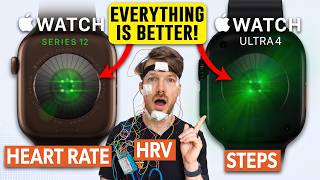
[05:44] from the raw sensor data. And I would call this a first-order derived metric. So, your PPG sensor, so that sensor with a green light underneath your watch, measures raw signals, and that somehow needs to be translated into an actual
[05:57] heart rate value. And this is a more or less direct translation, so no extra step required, which is why I would call it a first-order derived metric. hard, and not all brands perform the same here. And at least in my testing on
[06:12] my body, you can see huge differences between brands. But before looking at the different brands, let's actually see how important brand or sensor is for this. So, what I did is look at the heart rate accuracy, and then saw what
[06:27] factor is most important in determining a high or a low accuracy. And brand is super important here. However, within the brand, if there's an update in terms of sensor, there's only a small improvement or decline, usually
[06:43] an improvement, but sometimes also a decrease in accuracy. So, again, this is sort of indirect proof, but the fact that brand itself, so the sensor with that brand and the algorithms they have, is so much more important than even when
[06:56] a brand has a complete sensor overhaul, the improvements are usually quite small compared to the differences between brands. So, roughly, I would say five times more important than sensor changes within the brand.
[07:10] And probably many of the same algorithms are still used with the new sensor as were used with the old sensor, which is again what I suspect, but this is hard to prove, that algorithms, even for heart rate, are super important. And
[07:22] also, talking with some brands, I know this makes a huge difference, and also the approach there is super important. More about that in a second. First, I want to show you that indeed some brands are doing better on me than other
[07:35] brands. So, the further to the top right right here, the better the performance of the brand. And you can see that Pixel watches and also Apple watches right here were some of the best performers. And these are actually not typical
[07:49] sports brands, but more smart watch brands. And the fact that they're mostly outperforming sports brands is likely because of their algorithms and their AI expertise. So, in talking with different brands and also reading some of the
[08:03] papers that they published, they actually have a lot of calculations and a lot of AI involved in getting from that raw sensor data, which is super noisy, to your actual heart rate. And probably because they have both the
[08:15] people that know how to use this, they have all the control of merging that experience also with other products, they're really able to get a good life tracking of your heart rate with a good
[08:27] algorithm. Where smaller brands might struggle more to do this, where also more slow-moving smaller brands might not be able to get the best people to get the best out of their hardware. Now, I don't know this for sure, of course,
[08:39] but I really think that Google and Apple don't simply have better hardware, they just have more experience in artificial intelligence and of course the people that know how to train it. The signal is really noisy, you'd be surprised. That's
[08:52] multiple light sources and multiple sensors on the back. Those are just ways of reducing the noise, but at some point hardware doesn't cut it, you need software. Now, of course, sports watch brands are also doing this to some
[09:05] degree, so Coros, Garmin, Suunto, Polar. And they're doing a pretty okay job, but I suspect they just don't have the level of AI expertise that the major smart have. And that at least matches my testing. Now, there are major
[09:21] limitations to my testing, so for some people some other brands will also do very well, but I still think my reasoning is likely on the right track. But let's now move on to the third order the right metrics, because this is where
[09:35] I think there's going to be a huge gap between the brands. But before doing that, running this channel next to my full-time job as a scientist is neither easy or cheap. I normally have to pay my editor Alex. I actually edited this
[09:48] video myself. I bought a bunch of different cameras. Hello. And this is all not cheap. So, if you want to support and also support your wallet at the same time, if you end up buying any of these devices, whether it
[10:02] be an Apple Watch, an Amazfit device, maybe a Garmin, a Whoop strap, an Oura ring, or anything at all on Amazon for that matter, and you want the best discount possible, use one of my affiliate links in the description
[10:16] except for Amazon, which I cannot give you discount for, and you'll be supporting the channel at the same time. Thanks so much for considering. I actually also have YouTube memberships, which gives you early access to some of
[10:29] But let's get back to those third-order derived metrics. Now, recent developments in what are called foundation models are likely going to make the gap between health trackers even larger. This is what
[10:43] allows for the calculation of those third-order metrics, and these are mostly disease prediction models. But they might also include other things like injury prediction or really accurate recovery metrics. But I want to
[10:55] focus on disease prediction for now, which include things like heart and brain diseases. Now, foundation models are basically the exact sort of AI that ChatGPT is based on, but now, for instance, used for health tracking, and
[11:09] they're then directly applied to medicine and health. Now, in a recent study, it was shown that a single night of sleep in the sleep lab could predict which diseases you would get in the future with incredible accuracy, and all
[11:22] of that was based on a foundation model called SleepFM. Now, I won't dive into the details here. I actually made an entire video about that, which you can find up here. But AI for health is something many smartwatch and smart band
[11:35] companies are investing in. Some of this will likely be part of some sort of bubble, but a lot of it is actually valid science. We can actually see for instance based on job listings for many of the major health tracking companies
[11:48] like Whoop, Oura, Eight Sleep that they're investing a lot into AI specialists, and especially those familiar with foundation models. And I suspect that this is not to create a chatbot like ChatGPT, but to be more
[12:01] applied directly to health and disease prediction. They will probably do something similar as with Sleep FM, but instead of using data from the sleep lab, they will use data from your wearable to predict your
[12:14] odds of getting certain diseases like heart disease, maybe Alzheimer's, and years. These predictions are clearly playing at a different level, I would say, of health data and could have major
[12:28] positive, but also negative impacts on people's lives. I therefore call them third order because they're much less directly derived from the data and require a much more data and AI knowledge. And here is where I suspect
[12:42] some companies are going to get ahead, and some are going to fall far behind. whether this is a purely good development because I don't even know how many people want their smartwatch to predict different diseases. And in
[12:56] addition, there are issues with accuracy, availability, privacy, price, data security, and a widening gap between the rich and the poor in this world, even more than we already currently have in our society. But that
[13:10] is for a future video. In the meantime, I do hope you understand my reasoning, and maybe some of you will agree that this will likely widen the gap between for instance that Garmin decides, "No, we're going to purely stick with our
[13:25] sports tracking, and this whole health thing will keep at a basic level. But I would be very curious to hear about your opinions and why you would agree or disagree with my sort of hypothesis. So, please share that in the comments below.
[13:39] Keep it civil though. Now, if you do decide to get a new device, whether it be more sports focused like a Garmin watch or more health focused like a Whoop strap or an Oura Ring, you potentially want to improve your sleep
[13:52] with my favorite sleep improvement device the Eight Sleep Pod, you want to support the channel and get the best discounts possible, use one of my affiliate links in the description down below. That would really help me and
[14:04] also help your wallet. Now, given that you watched this whole video on the importance of software over hardware, check out this video on Sleep FM, a really exciting foundation model, or this video on the Eight Sleep Pod, my
[14:17] this video on the Eight Sleep Pod, my favorite sleep improvement device.
⚡ Saved you 0h 14m reading this? Transcribe any YouTube video for free — no signup needed.