
AI Summary
This video explores the history and evolution of fiber optic Christmas decorations, contrasting the warm, filtered incandescent lighting of the past with the harsh, monochromatic output of modern LEDs. The creator argues that while LEDs have improved efficiency, they have ruined the nostalgic aesthetic of holiday lighting, and offers a solution through specialized manufacturers.
Chapters
The video is part of a series called 'No Effort November' where the creator makes minimal effort. The topic is how LEDs have ruined the warm and joyful vibe of holiday decorations.
Traditional Christmas lights used incandescence: electric current made a filament white hot, and colored glass filters tinted the white light. This produced warm, natural colors.
Fiber optic lighting had three waves. The first wave was in the 1960s, originating from a company called Electro Fiber Optics in Massachusetts, which created the 'Fantasia Light' after a legal dispute.
The second wave in the early 1980s featured fiber optic flower lamps, often made in Belgium or Taiwan. They used a bundle of fibers above a light bulb and a rotating color wheel to create shimmering effects.
The third wave, possibly inspired by the 1982 movie 'Tron', saw fiber optics used everywhere, including in concrete at EPCOT's Future World. This wave used brighter halogen lamps, often 12V, with integrated reflectors.
The creator highlights the beauty of fiber optic displays with color wheels, which rotate at 6 RPM and create a vibrant, dynamic, and mesmerizing effect. The color wheel is key to the natural blending of colors.
Modern fiber optic decorations use RGB LEDs instead of color wheels. This results in static, monochromatic colors with no blending, which looks unnatural and 'gamer vomit'.
RGB LEDs produce 100% saturated, monochromatic light. The emitters are in slightly different locations, causing color fringing and preventing natural blending. This is why LED fiber optics look inferior.
The creator tested a 3W warm white LED drop-in lamp in a fiber optic tree that originally used a 20W halogen. The colors were nearly identical, proving that the color wheel, not the light source, is key to the aesthetic.
Unlike fiber optics, LED Christmas lights use colored diodes that produce monochromatic light, which is unnatural. The color balance is also off, with cooler colors like blue being too bright and harsh.
The creator recommends Tru-Tone and Merry Co, which make LED Christmas lights that use warm white LEDs under colored glass filters, mimicking incandescent lights perfectly. They are the only options that truly match the traditional look.
Warm white LEDs are not truly white; they use phosphors to convert blue/UV light to a mix of wavelengths. This spiky spectrum can interact with color filters differently than the full spectrum of incandescent light, causing color shifts.
Most big box stores sell either power-hungry incandescents or 'gamer vomit' LEDs. A few options like Sylvania Traditional Glow at Target are decent, but most 'vintage' claims are lies.
The creator argues that the efficiency of LEDs has led to an overabundance of lighting, which is not always better. Christmas lights should be subtle points of light, not illumination.
Menards sells a fiber optic tinsel tree that uses an LED with a rotating color wheel, proving the technology is still alive. The effect is pleasant, though the color wheel spins slower.
Menards also sells Christmas lights with LED filaments inside glass bulbs. These have a more pastel, less saturated color, which is a step in the right direction but still not perfect.
The creator hopes for a resurgence of subtle, warm lighting and believes LEDs can be a major improvement if used correctly, such as replicating the look of color wheels with RGB LEDs.
The video concludes that while LEDs have ruined the traditional aesthetic of Christmas lights and fiber optics, there are solutions available from niche manufacturers like Tru-Tone and Merry Co. The creator remains hopeful that the industry will eventually embrace phosphor-corrected LEDs and color wheels to recreate the warm, nostalgic look of incandescent lighting.
Mentioned in this Video
💡 Key Takeaways
Incandescence explained
Provides a clear, simple explanation of how traditional Christmas lights worked, setting up the contrast with LEDs.
01:02Origin of fiber optic lighting
Reveals the surprising history of fiber optics in consumer products, starting with a company in Massachusetts.
02:31The magic of color wheels
Highlights the key mechanism that makes fiber optic displays beautiful, emphasizing the importance of color blending.
06:41LED drop-in test
Demonstrates that the color wheel, not the light source, is responsible for the pleasing colors, offering a practical solution.
11:32Phosphor LED spectrum
Explains the technical reason why LED colors can shift when filtered, a key insight for understanding color science.
18:35The problem of more
Challenges the assumption that more lighting is better, advocating for a more subtle and tasteful approach.
28:18Full Transcript
[00:00] and which the LED has once again ruined. Hello and welcome to No Effort November, a series of videos for the month of November where no effort is made.
[00:16] I am fortunate to have grown up during what I believe was the third time The third wave was especially concentrated We were sticking fiber optics into Christmas trees, jack o lantern,
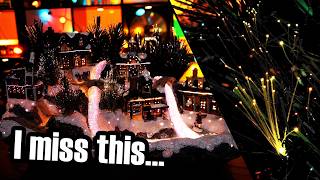
[00:34] those weird Christmas village things, and even Santa Claus himself. And it's frankly a stunningly beautiful display of colorful light Well, at least displays like this.
[00:48] Christmas colors complaint video, as much as the light emitting diode has improved our lives tremendously it absolutely ruined the warm and joyful vibe of holiday decorations.
[01:02] We used to make artificial light happen by running electric current which caused it to get literally white hot.
[01:14] is what lit our houses, and that's incandescence. when it came to Christmas lights, Which meant if you wanted to produce colored lights,
[01:30] white light source and using color filters to tint it. Filter out the colors you don't want and let pass the colors you do. Don't worry, I will be exploring and complaining about the current state of the Christmas like market.
[01:48] But for now, let's take a look at these beauties. also quite beautiful fiber optic flower things were, I believe, part of the second fiber optic fad, which hit in the early ‘80s.
[02:03] The first wave of fiber optic lighting tat is very interesting from a historical perspective. So while I don't have an example to show you, I'll give a brief overview. but their use in computing equipment actually goes way back.
[02:17] which made them useful for designing optical scanners which read punchcards. in a completely different location Apparently, one of the companies
[02:31] for those systems, Electro Fiber Optics in Massachusetts, So to keep their business afloat, they started looking for new angles from another company which was in legal trouble.
[02:45] which they called the Fantasia Light. and eventually they became popular enough Spencer Gifts.
[02:58] Basically just a globe of fibers poking out of a stick. And as you can tell from the box, they came in a crap ton of varieties.
[03:12] into some sort of display created quite an interesting effect. I particularly like how the leaves and petals are sort of edge-lit. Apparently a Belgian company called Massive
[03:27] started making them in the ‘80s before production moved overseas, made in Belgium, as many early examples say And this one was indeed made in Taiwan.
[03:40] Also, it has a music box in it While I imagine these were pretty fiddly to manufacture, There's a bundle of optical fibers in the base of this thing
[03:54] The bundle is sitting directly above a light bulb and a rotating color wheel. will tint the color of light coming from that light bulb.
[04:07] is sitting over a different spot on that wheel, Also, the wheel will often incorporate different patterns to create shimmering animations like you see here.
[04:21] all the way to the third wave of fiber optics, And that wave is when we went absolutely nuts.
[04:33] brought the topic of fiber optics into everyday conversation, but that's just speculation on my part. However, we definitely went nuts.
[04:48] Even concrete! As you can see from this footage of pre-ruined Future World at EPCOT. but it turns out they were installed
[05:03] And they are dearly missed. And in this third wave of fiber optics, But we did learn a few good lessons.
[05:18] we see in the flower lamp was replaced I believe we moved to 12 volt bulbs because these were commonly used in low voltage landscape lighting
[05:32] 5 or 10 watt lamps are very common in these sorts of things But because they were halogen, and because they had an integrated reflector pointing nearly
[05:48] and into the bundle of optical fibers, the overall effect was a much brighter display But we did go higher than ten watts depending on what we were doing.
[06:03] And this fella has a 20 watt lamp in its base. so nothing gets hot enough to need a cooling fan,
[06:15] but direct 20W of halogen light through a bundle of optical fibers, Fancier models like this would even come with multiple color wheels to provide different animations, if you'd like.
[06:29] and only came with the kaleidoscope color wheel seen here, That to me is what makes these so magical.
[06:41] and the pumpkin and Santa are slightly smaller, There's a tiny section of fibers that are only getting white light, This, to me is what fiber optics have always looked like,
[06:58] The color wheel rotates at 6 RPM, But because there are so many optical fibers it's difficult to notice any patterns other than
[07:15] It's a vibrant and dynamic display, I dunno, just really pleases my brain parts.
[07:27] the direction the wheel spins when you power it up so the pattern will periodically run in reverse. So why has the LED ruined fiber optics?
[07:43] with which you can make all sorts of pretty colors, So tempting, in fact, that this has already happened.
[07:55] my mom got me this rather sad Christmas tree as something of a gag gift. But it is fiber optic.
[08:08] However, its light source is It's three red, two green, and two blue LEDs And the effect is this.
[08:21] Nothing is physically moving, so you can very clearly And while there is a bit of blending between the colors, there's not nearly enough.
[08:36] True RGB LEDs would be an improvement, Now, knowing that fiber optic and knowing that this terrible thing exists,
[08:52] fiber optic scene looks like these days. artificial star fields, is alive and well Those party busses don't just materialize.
[09:06] You get an emitter and a great big bundle of optical fibers I have to admit, my hopes were very low seeing one of these remotes.
[09:19] But much to my surprise, there actually is a rotating wheel of a sort. In fact RGBW LEDs.
[09:31] But in front of them is a wheel with Swiss cheese-esque holes in it. And that wheel, when it rotates creates a very pleasant shimmering effect. given that there are just four LEDs in there, but apparently enough light
[09:46] bounces around to make all the optical fibers glow quite brightly, It's really good. Now look, this is a sample size of one,
[10:01] I also know that a star field is a very different kind of effect and we wouldn't necessarily want a kaleidoscope of colors. every color they can produce is 100% saturated.
[10:18] especially because these are RGBW chips, the effect wouldn't quite work right because the emitters on those chips are in slightly different locations.
[10:33] we don't get a cluster of cyan stars. keep switching back and forth between blue and green.
[10:46] That's not necessarily a bad effect, but it does mean the RGB-ness of this thing is impossible to hide. And any attempt to desaturate the color will not work as you expect.
[10:59] put out the same colors that your gaming PC can. and I can't believe I'm going to say this word, and a color wheel is what makes their colors so varied and unique.
[11:17] like the output of colored LEDs. you get natural blending between the colors. And of course, can do cool stuff like the shimmering effect.
[11:32] with a bunch of LEDs behind a cheese wheel. However, while these came with halogen lamps, There are all sorts of 12 volt LED options now
[11:50] meant as drop ins for these 12 volt halogen lamps, it's probably going to look pretty darn similar. Here's a side by side comparison with the Christmas tree.
[12:05] They look almost exactly the same. The tree on the left has the stock 20W halogen lamp in it, and the tree on the right has a 3W warm white LED drop in -
[12:17] which is actually slightly warmer in color temperature than the halogen lamp. the LED drop in is the more typical 2700 Kelvin Anyway, other than the increase in warmth, which I will note
[12:34] the colors are practically identical. It's almost like we've been making a false choice between oversaturated LED gamer vomit and the pleasing colors of my past.
[12:48] In this shot, the lens is defocused to make the colors more clear. And if I weren't looking at these side by side, I'd be hard pressed to see a difference at all.
[13:00] and while the blue is a bit punchier The camera is skewing things a bit, is that the red has shifted much more to orange with the LED.
[13:19] given that its power consumption went from 21-ish watts to 4-ish watts, However, the green,
[13:31] went from a beautiful emerald green to a slightly sickly green. Overall, though, the switch to an LED lamp had a very minor effect
[13:46] because it's not the thing making the colors happen. with what's happened to Christmas lights. When it comes to literally every other kind of LED replacement light source,
[14:01] manufacturers have taken great pains to mimic the appearance of incandescent light. And heck, we're even making glass light bulbs with LED filaments inside them
[14:13] just because so many people expect light bulbs to look like this. almost nobody has been trying And those who have truly do not get what the problem actually is.
[14:31] For example, this set of Christmas lights from Ace Hardware They've got a nostalgic look and according to this bolded text,
[14:43] But let's test that. Here is a set of incandescent lights in the same color scheme. Now, here are the LEDs.
[14:57] Exactly. They don't! what the actual miniature bulb looks like.
[15:14] but nobody's getting close enough The problem is the color! And it stems from the actual technology in use.
[15:28] The diodes under the glass are themselves producing colored light, just like the RGB LEDs in the fiber optic emitter. The glass is colored to match the diode underneath,
[15:43] but it's not doing any filtering because the diodes themselves That monochromatic light is literally as vivid as a color can possibly be. And least to me, looks very unnatural.
[15:58] To make matters worse, because LEDs can be so incredibly bright, the color balance of a multi-colored light set shifted way See, because we used to be dealing with tungsten
[16:13] the light source we were filtering is biased towards So the cooler colors like green and especially blue,
[16:25] are much less bright than the warmer colors like reds, oranges, and yellows. We can see that quite plainly in the fiber optic Christmas tree. The blue, while still an intense blue, is quite dark compared to the other colors.
[16:40] for warm lighting, which not everyone shares. and especially blues are in a set of Christmas lights like this,
[16:54] for well more than a decade now, people have been decorating their homes than a warm and inviting festive display. I want Christmas lights, not kratom lights.
[17:09] Now the good news is that it doesn't just annoy me. So much so that at least two other people So here's my yearly free brand deal
[17:24] for the fine folks at Tru-Tone and Merry Co. to a manufacturer that yes, actually, which don't use colored diodes, but are instead
[17:40] Those Christmas lights behind me And by the way, you can still buy incandescent Christmas lights in the US.
[17:52] Which is why this has been so infuriating to me. Every lighting manufacturer has been making really good LED incandescent mimics of all sorts for years now.
[18:05] are this elusive mystery. Guys, just shove a warm white LED under colored glass. We know we can have the best of both worlds.
[18:19] But I made a little fib with the word “just” there. made the emerald green in the fiber optic tree a little sickly? are not actually white.
[18:35] works on the same principle as fluorescent lights did. LED is a mix of phosphors, which are sitting on top of the actual light emitting diode.
[18:49] The diode itself emits blue or increasingly often near UV light, and the phosphors absorb those high energy light wavelengths and release a concoction of lower energy, longer wavelengths.
[19:03] what looks like a very natural white to our human eyes, of spiky wavelengths, and not the true full spectrum
[19:15] output of hot, glowing wires. is what caused the colors to move around a bit. because the red pigment in the color wheel
[19:31] With a halogen lamp, that entire range is present but with an LED lamp there are gaps in its output.
[19:43] its output gaps land in such a way that the filter lets through a larger proportion of the shorter wavelengths that are close to green.
[19:55] the apparent color towards orange. coming from the light source, and depending on how they interact with a color filter, the end result can look off.
[20:08] Making this even harder to judge is that the subpixels in a camera sensor So the color balance in the image captured by a camera
[20:20] For instance, I wanted to show you a dramatic difference in this Christmas The teal color shown here is dramatically muted but the camera renders them almost exactly the same.
[20:38] I've said it before, but color science is very weird, you get by filtering an incandescent filament using a white Luckily for us, though, passionate lighting nerds
[20:55] But it really does take a passion. have been dialing in both the color filters and the diodes underneath them to actually
[21:09] Make LED Christmas lights which match incandescent exactly. where you recognize there's a false choice between efficient
[21:23] LED lighting and a traditional appearance, please check them out. and while they're not paying me to say any of this, they are very much worth your money and right now are the only options on the market
[21:38] Tru-Tone mostly specializes in the larger C7 and they are truly amazing. options are a perfect match for incandescent,
[21:55] and I've had a set of the Jewel Tone bulbs outdoors for two seasons now, What's more, they now offer them in either traditional glass or a shatterproof polycarbonate option.
[22:09] And now they do have mini-lights. are a bang on match to the incandescent lights they're trying to mimic. Also, and this is important for those of you who are sensitive to flicker,
[22:24] So if you've been bothered by the appearance of LED Christmas lights when you move your eyes around, these do not have that problem. There is a trade-off: the DC power supply limits how many sets you can connect together,
[22:39] but it's basically the same number of sets as the incandescent days. Merry Co, on the other hand, has gone all in on mini lights and their decision to release them first in my preferred color set of
[22:51] red, yellow, green, and blue made me very excited once I discovered them. I mentioned them, and now I have essentially no nits to pick.
[23:03] And soon they'll have icicle lights. Look, I don't hate blue Christmas lights. These look awesome because they're not the weird
[23:17] monochromatic blue which your eyes can't quite focus on correctly, which look pleasing and perfect. I just notice things.
[23:31] DC power supplies in their mini lights. So if you notice the flicker of an LED light set and that bothers you, They are full-wave rectified so they flicker less than many sets.
[23:45] when I move my eyes, it doesn't bother me at all. is that you can string together a ridiculous number of light sets, because we Americans just run raw mains voltage through these things.
[24:00] that Target was selling a fairly decent set of LED mini lights, branded as Sylvania Traditional Glow. Tru-Tone and Vintaglow.
[24:16] independent companies who actually got this ball rolling, what I really want is for not crap LED Christmas lights to be accessible So of course, I once again
[24:32] to see if anything has improved. And quite sadly, the picture is exactly the same as it was last year. Those same lights are available at Target again.
[24:46] very bad. lights, and it's particularly disappointing in this context.
[24:59] but my hopes that they would have improved this product were quashed. Still, I'm happy to see this option on the shelf of a major retailer, Everything else is either genuinely incandescent with its same power-hungry,
[25:16] or gamer vomit. in the land of C7 and C9s. There are plenty of decent options for frosted multicolor sets,
[25:30] lies or somewhat mid. from Home Depot, and they at least have the right idea.
[25:42] the blue light in that display tube was by the end of last year's holiday light season, Maybe they've been improved for this year,
[25:56] and the one in that tube made it at least a few weeks before fading much, it at all. If they fade simply due to the light They're definitely not going to last long outside.
[26:12] That is the one upside to colored diodes that I'll acknowledge, but I would much rather have faded colors than gamer vomit. But other than this product
[26:25] and that product, the only options you'll find at Target, Walmart, Lowe's, Home Depot, Ace Hardware and Menards are either power hungry incandescents or...
[26:37] I must press on the fact that most stores are selling options now which claim to be vintage or traditional or something like that, but most of those boxes are lying.
[26:52] “these look like traditional Christmas lights” so long as they're not lit. But when they are lit and, they look nothing like incandescent Christmas lights.
[27:08] You have to plug them in and check for yourself. due to how awful Christmas lights have become.
[27:20] If you see that weird halo around the blue lights, Side note, I really hate how smartphone
[27:32] cameras render colored points of light these days. Whatever high dynamic range processing nonsense is going on there is just... It's gonna be blown out.
[27:45] Anyway, the good news about this weird rendering we're stuck with now is that it makes monochromatic LEDs very obvious. to that particular thing, there's a good test for you.
[28:00] what modern LED Christmas lights look like, stepping back from Christmas lights. is that it's way too easy to go overboard with them.
[28:18] Now that electrical consumption of lighting has been dramatically cut, we’re stuck in the rut of more. think we should disarm.
[28:31] - is supposed to be dark. Not to recreate sunlight. And to bring it back to Christmas lights.
[28:48] from seeing go all out with their decorations I'm sure your neighbors are saying to your face But if you could take the time to notice
[29:05] you might get a sense of their true thoughts, Anyway, perhaps I'm fighting a losing battle here. Shortly after I made my hallelujah video
[29:19] I got a message from someone on Patreon they weren't very bright. but that's the whole point!
[29:34] I want to decorate my home using tiny points But I want to do that with modern technology, which doesn't waste energy.
[29:47] The purpose of Christmas lights is not to illuminate their surroundings, And while I know different people have different definitions of appealing, my problem has always been that I simply cannot
[30:02] and will not ever find monochromatic, piercingly bright clusters of color let alone seasonally appropriate. amongst this year's big box Christmas light market research.
[30:20] if any fiber optic stuff was for sale. I also checked online to see if stock had simply run out. overall fiber optics in Christmas lights appeared to be very dead.
[30:38] But Menards had one option: this. but when I saw it on display, I realized the colors were behaving like I would expect them to.
[30:51] And sure enough, though the light source is now an LED... Turns out it's not quite dead. The color wheel now spins more slowly,
[31:06] And it's easy to check where it loops due to this moment where it goes I don't even mind that it's being illuminated with a cool white LED - Now I haven't shown you its whole deal quite yet.
[31:24] which sends power to a bunch of white LEDs that statically illuminate various optical fiber clusters. The star is okay, but the rest of the clusters
[31:38] are a little too bright and overwhelm the color changing clusters. Plus, it's not the same white as the LED in the base, So I appreciate that you can just unplug that.
[31:53] get any light, but I think it looks much better. so only the star was lit, it - I'm not even going to fix that flub.
[32:07] led in some of the vintage things. Apparently it's not that cool, since while it's definitely a dramatic change, it's not quite as crisp of the white as the new tinsel tree.
[32:20] but the other reason I did this was to see whether this style LEDs on its face would work as well as one with a lens.
[32:33] But I will warn you, if you intend to use an LED which had a five watt halogen lamp, These 3W replacements are nearly as bright as the 20W halogen lamp in the Christmas tree.
[32:54] when used tastefully. I'm pretty much done here, but I have two more quick things to share. Menards also had these very goofy Christmas lights
[33:07] I am almost 100% certain but this year they got LED filaments inside of them
[33:19] The blue is not very deep at all, and honestly, So I think it's going for a vaguely pastel color scheme, What am I going to do with these?
[33:34] Pretty. If the world cannot be convinced of the merits well, multicolored LEDs don't have to be awful.
[33:51] and while it's definitely not my preference, swapping the deep PlayStation 2 blue for a teal or cyan-adjacent color is a huge improvement to me.
[34:06] now that are phosphor corrected and thus aren’t truly monochromatic, and that's the case for at least some of these. balance than most multicolored light strands.
[34:21] Most notably, the yellow and red are actually quite bright. I still find the colors to be too artificial, and it still illuminates the room like an underwater scene.
[34:33] But I could live with this. But I will at least be somewhat less angry So hop to it.
[34:48] But I'd rather you hop to the websites of Tru-Tone and Merry Co. to truly dial in those classic colors, and I genuinely think they should be rewarded for their efforts.
[35:01] I'm plugging two competitors at the same time! return to a more subtle vibe. And well, I'd love to see a resurgence
[35:15] There, I actually think the LED can be a major improvement. to replicate the look of the color wheel using RGB LEDs.
[35:28] I totally figured color wheels had gone the way of the dodo. They're probably still endangered, but for now, they're still spinning.
[35:40] ♫ a jazzy rendition of “We Wish You a Merry Christmas” ♫ During my eBay adventures where I was looking for
[35:52] weird and short set of string lights, They're not made well at all. from the optical fibers, so they're barely glowing.
[36:06] The retail price on this is $40, and that is potentially 1995 money. This is a horrible value, but, um.... it sure was a thing for a while.
[36:25] And apparently that makes it fair game. which they called the Fantasia Light. long is it going to take for
[36:38] that to stop playing? [music box plays slowly on]
[36:52] I should have just done that in b roll, shouldn't I? [it’s still goin’]
[37:06] Ooh! We can have the best of both worlds. Okay, that was a little over the top, wasn't it?