[00:00]
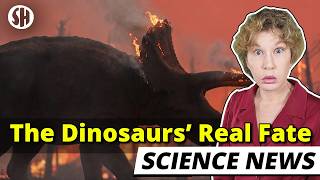
We might finally know how the dinosaurs died. And it was much more horrific than we thought. This is what the authors of a recent study say. Let’s have a look. Sixty-six million years ago, an asteroid hit Earth and wiped out the dinosaurs. That much,
[00:24]
pretty much everyone agrees on. We know where the asteroid hit, it was at the edge of the Gulf of Mexico, formerly known as the Gulf of Mexico. And we know roughly how big it was, it had a diameter
[00:37]
of about 10-15 kilometres. And we know that the aftermath of the impact changed the climate on planet Earth for years because all the debris that was blasted into the atmosphere dimmed the sun.
[00:50]
But what exactly killed the dinosaurs? As devastating as the asteroid impact itself was, it was a local event. It wouldn’t have killed all dinosaurs on the planet. The current leading hypothesis has it that it was the dimming of the sun that caused the widespread extinction. Plants
[01:07]
died, and all animals that lived off them, and then the animals that lived off these animals, and so on. Entire food chains broke down. This would have taken years to play out. But the new calculations now say that many of the dinosaurs died within
[01:21]
hours of the impact in the most gruesome way: They burned to death. They say what happened is roughly the following. The asteroid hit the edge of the Gulf of Mexico. This created enormous amounts of pressure and with that, heat. The heat didn’t just evaporate water,
[01:38]
it vaporised enormous amounts of rock as well. With the impact, a lot of that vaporised rock was blasted high into the atmosphere. But this is not the fine dust that stays up there for years and dims the sun. It
[01:52]
doesn’t go high enough for that, and it’s not distributed thinly enough. Instead, much of this vaporised rock condensed into tiny droplets. Those droplets then fell back to Earth. And now here comes the important point:
[02:05]
they fell through the atmosphere at enormous speed. That created a lot of heat. And because of all the other dust above the falling droplets, the heat couldn’t escape. This leads to a sudden, global increase of temperature, high enough to set plants on fire, and pretty much everywhere.
[02:22]
This insight isn’t entirely new. Scientists have known for decades that the immediate aftermath of the impact would have caused a short burst of heat at the surface. But previous calculations said that it wasn’t hot enough to ignite vegetation. The authors of the
[02:38]
new paper now took into account recent evidence that updates the scenario. This recent evidence is that scientists found in sediments a lot of fine silicate dust from the impact. The previous calculations left out this fine dust that was also in the atmosphere. And the authors of the
[02:54]
new paper now say that if one properly adds this dust, then this heat-burst gets so much worse. Indeed they calculate that the thermal radiation created by the impact would have been lethal to humans. It would also have immediately cooked any animals caught
[03:11]
in the open. It was strong enough to set fire to dry vegetation immediately, maybe even healthy trees. Most other animals on land would then have perished in the fires. And all of this happened surprisingly quickly. It just took a few hours to play out, so many
[03:28]
dinosaurs may not have spent weeks or months wandering around an increasingly cold and barren planet. They may have died on the same day that the asteroid hit. The particularly nasty part is
[03:41]
that it may have happened largely in darkness, because the same tiny particles that blocked infrared radiation from escaping also blocked visible light. The fires themselves would have provided some light, but otherwise there may have been very little to see. Basically, hell on earth.
[03:59]
This would not have killed all animals though. An animal inside a burrow, under water, or otherwise shielded from the sky would have absorbed far less of the radiation. Small mammals might have been able to hide underground, many reptiles and
[04:14]
amphibians could seek shelter in water. But a ten-tonne land dinosaur had nowhere to go. The researchers are not claiming that every dinosaur everywhere dropped dead within an hour. Maybe there were parts of the planet that didn’t burn, maybe some got just lucky.
[04:31]
But their calculations show that the immediate aftermath of the impact could have been considerably more destructive than scientists previously thought. And surviving the first few hours was only the beginning,
[04:45]
because once the returning debris had stopped heating the atmosphere, the dust was still there to block the sunlight which killed many of the remaining plants and animals. The worst part is, you know, it could happen again. As Tori Amos put it so well, “Doesn’t take
[05:02]
much to tear us into pieces.” Life is fragile. Better get started on that asteroid blaster. You know what used to be the worst part about research for me? dealing with PDFs and yet there's
[05:16]
no way around them. But today's sponsor UPDF has solved this problem for me and maybe they can help you too. With UPDF, I can edit text and images directly, annotate key findings and reorganize
[05:30]
pages without having to rebuild the document. It can even deal with scanned sources because it's got an optical recognition that turns scans into editable text. And when I need the content
[05:42]
elsewhere, I can convert the PDF to Word or Excel. UPDF can also fill and sign forms, protect important files, and in case you the US government redact the interesting names. UPDF also comes with
[05:56]
a built-in AI that can summarize papers, answer content questions, or translate the paper while preserving the layout. It even helps me research related work and it all works across desktop and
[06:10]
mobile. And here comes my limited special offer. If you use my link, you'll get a special discount for UPDF Pro. So go and check this out. Links in the info. Thanks for watching. See you tomorrow.