
AI Summary
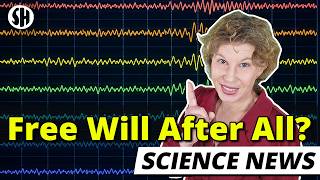
This video challenges the long-held neuroscientific claim that free will is an illusion, based on Libet's experiments. The host presents three recent studies that question the interpretation of these results, offering a more nuanced view of decision-making.
Libet found brain activity predicting finger movement before conscious awareness, undermining free will; this has been reproduced many times.
A London team improved the method by having participants type random words and asking if they knew the next word; brain signals were stronger when decisions were made.
They concluded that conscious intentions are not merely retrospective confabulations, challenging the standard interpretation.
Thomas James argues that decisions are processes, not sudden moments; early brain activity is part of the process, not an unconscious decision.
The experiment showed that decisions take non-zero time, not that free will is an illusion.
An Australian team found that people primed to disbelieve free will reported more self-forgiveness and forgiveness toward others, contradicting previous claims that free-will disbelief leads to immorality.
The host argues responsibility depends on preventability, not free will; Bob is responsible for eating a donut because a warning could prevent it, but not for sneezing.
Mentioned in this Video
💡 Key Takeaways
Libet's 1983 experiment
Foundational study that sparked the modern free-will debate in neuroscience.
00:31Improved experimental method
London team's method addresses the methodological flaw of self-reporting consciousness.
01:20Decision as process, not moment
Shifts the framing from a binary moment to a continuous process, undermining prior conclusions.
02:31Responsibility without free will
Argues responsibility depends on preventability, not metaphysical free will, resolving a common confusion.
04:42Full Transcript
[00:00] Does free will exist? Some people care about this question. For decades, neuroscientists have argued that we make decisions before we become consciously aware of it, so free will is an illusion. And at the same time, sociologists have argued that it's nevertheless
[00:18] a useful illusion because it makes us better people. Well, today I have three recent studies, each interesting in its own way, that totally change this discussion. Let's have a look. In an
[00:31] a now famous experiment from 1983, the neurologist Benjamin Libet found that people's brain activity shows they'll move a finger before they knew themselves that they will move. This finding
[00:44] has been independently reproduced many times since. Bad news for free will, but excellent news for anyone whose finger has done something regrettable on the internet. The first paper that I have today sheds doubt not on the experimental results themselves, but on their interpretation.
[01:02] You see, the problem with Libet's experiment is that people were asked to report when they became consciously aware of something. "But, please tell us exactly when your consciousness happened" is perhaps not neuroscience's finest measuring instrument. A team from London has now improved
[01:20] the method. They recruited 51 people to type random words in certain categories like animals while their brain activity was measured. Between the words, they were told to briefly pause. In
[01:34] that pause, the researchers randomly interrupted them to ask if they already knew what the next word would be. The brain measurement showed that if the participants had already made up their mind, then the brain signal that indicated their coming action was stronger. They conclude
[01:52] that it's not true that we make decisions first and then become consciously aware of them and invent that it was our decision. As they write, "These results are difficult to reconcile with the
[02:05] view that experiences of conscious intention are merely a retrospective confabulation." The second new paper that I have today supports this finding with a general argument. It comes from cognitive
[02:17] neuroscientist Thomas James, who questions the assumptions behind the usual interpretation. Neuroscientists usually describe behavior as a sequence: perception, decision, action.
[02:31] James says, "This isn't what happens. There's no sudden decision moment. Rather, what we call a decision is the process in which sensory input and motor processes develop to result in an action
[02:44] or not." In this interpretation, the early brain activity that Libet and others observed was not an unconscious decision. It was merely an early part of the process that produced the action and the
[02:57] experience of having made a decision. Basically, he says the experiment that supposedly killed free will merely showed that decisions take non-zero time. By the way, a simple way to support this
[03:09] channel is to buy a t-shirt or a mug in our store. And the third paper I have today comes from an Australian team which re-examines the claim that people who are primed to question their free will
[03:21] are more likely to support morally questionable actions, such as cheating on tasks. There's been a whole number of studies which seem to support this claim. They usually work by giving people some
[03:33] passages to read that say basically, "Your actions are predetermined by whatever input your brain receives." And then asking the people basically whether people are to blame for their actions.
[03:45] Unsurprisingly, usually these studies find that at least temporarily people say, "No." more often. Hence, free will disbelievers are immoral. Well, the new study now looked at the question differently. Rather than asking people prompted to disbelieve free will about moral failings,
[04:01] they asked them to recall either a time they'd hurt someone or a time someone had hurt them. Those who then read arguments that free will is an illusion later reported more self-forgiveness and
[04:14] more forgiveness towards others. Honestly, I think all these psychology studies are [ __ ] one way or another. The problem is that the way they prompt people to disbelieve in free will really prompts
[04:26] them to believe that people are not responsible for their actions. This makes zero sense though, because look, whether your brain gives you free will or not, it's still you, your brain, that results in an action or not. The question of who or what's responsible comes down to the
[04:42] question of what measure could have prevented the result. If Bob sneezes, could he have prevented this by telling him not to sneeze? Probably not. If Bob eats Eva's donut, could you have prevented
[04:55] this by warning him you'll find out and make him clean the toilet? More likely. Hence, you make Bob responsible for theft, but not responsible for sneezing. Nothing about this requires mentioning free will. So much about the psychology papers. I give the two neurology papers each an 8 out of
[05:13] 10 on the [ __ ] meter. This is because despite all the educated sounding talk, the entire field still suffers from a definition problem. What is it that you're even looking for when you speak of
[05:25] a conscious decision? The reason I'm telling you about this nevertheless is that this is a research area where I expect a lot to happen in the next decade, partly because of a better understanding of the human brain, but also because artificial intelligence will serve as a test case for what
[05:42] it means to think, make decisions, and be aware of something. 40 years of philosophical panic and in the end the discovery was latency. If you want to stay safe on the internet,
[05:55] I can really recommend NordVPN, which I've been using for many years. It's a high quality product that acts as a data filter between you and the bigger internet. It only lets in and out what you
[06:08] want. NordVPN is an app that you install on your phone or laptop. It provides a secure and private connection for your internet browsing through one of their thousands of servers all over the world.
[06:20] NordVPN also regularly updates its service. They now offer an all around virus protection of the next generation, not just against malware, but also trackers and scammers and whatever the next
[06:33] cause will be that AI brings upon us. NordVPN also has a post quantum encryption and one of the great benefits of using NordVPN is that it's super handy to access websites in other countries that are
[06:45] blocked for visitors from elsewhere. All you need to do is use a server in the respective country and Nord has thousands of those. NordVPN is an easy and effective way to maintain your privacy
[06:57] online and of course I have a special offer. All you have to do is use my link nordvpn.com/sabine or use the coupon code SABINE. So go and check this out. Thanks for watching. See you tomorrow.